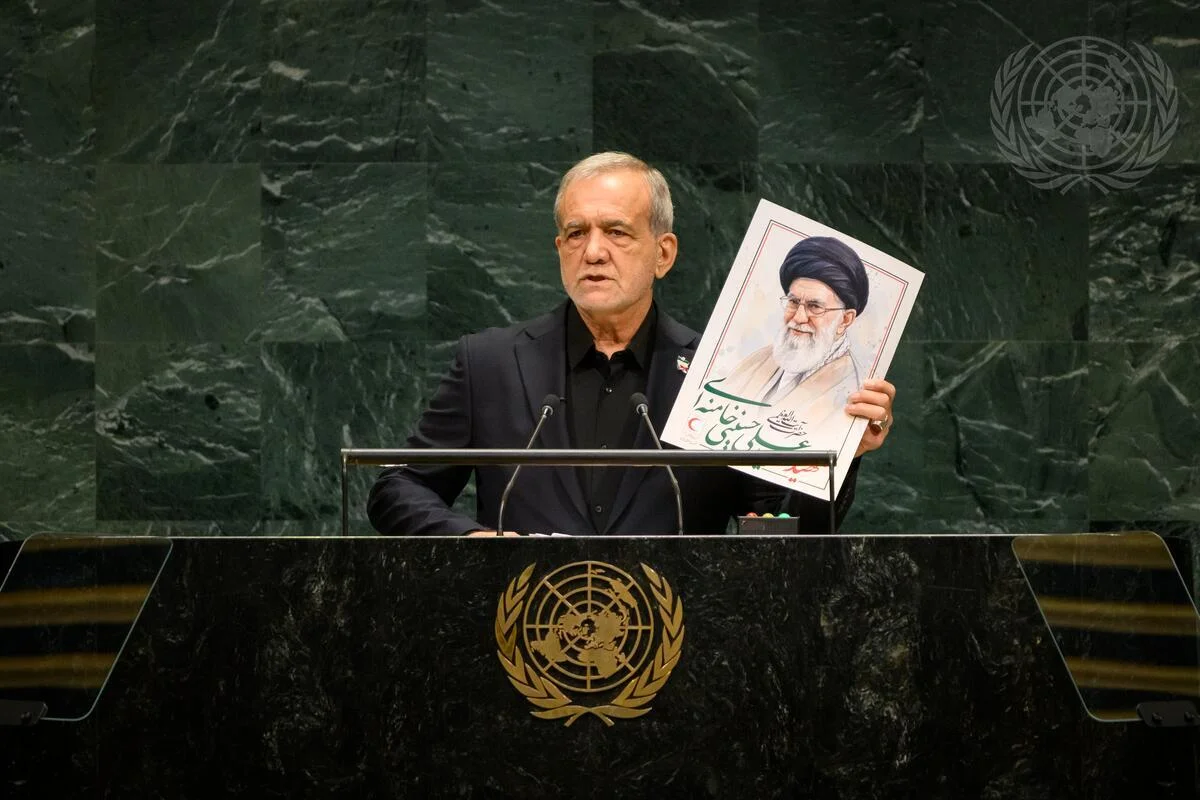
On Wednesday, September 23, Iran's President Masoud Pezeshkian delivered a speech during the General Debate of the 81st session of the United Nations General Assembly. The president stated that the Iranian people had been victims of terrorism by the United States (US). Furthermore, he displayed a photograph of the previous Supreme Leader, Ali Khamenei, who died after the February attacks, and of the more than 150 students who lost their lives as a result of an attack on a school. For his part, US President Donald Trump maintains his strategy of expressing himself ambiguously regarding the conflict with Iran. One day before Pezeshkian's speech, he stated that he could “annihilate” the Islamic Republic if a quick agreement was not reached after seven months of war. Subsequently, he announced that his envoys to New York, Steve Witkoff and Jared Kushner, met with Iranian officials. While he offered few details of the conversations, he highlighted the usefulness of the meeting. However, from the Iranian perspective, it was noted that the meeting brought nothing new. During the conversations, the spokesman for Iran's Ministry of Foreign Affairs, Esmail Baghaei, reaffirmed the country's position. The official demanded that Washington release frozen Iranian assets and end the blockade of ports in its territory. Pezeshkian's forceful speech took place in a context of sporadic attacks in the Strait of Hormuz and intermittent meetings between Iran and the US which, to date, have not concluded in a lasting agreement. It is worth remembering that on June 17, a ceasefire had been reached which collapsed just 21 days later, when Trump officially announced the resumption of attacks. The conflict between Iran, the US, and Israel has now lasted almost seven months, during which Trump has not been able to achieve two main objectives: overthrowing the regime and negotiating a new nuclear agreement. In turn, Netanyahu has had even less success in his efforts to completely destroy the Iranian nuclear program. On the other hand, several Middle East countries with US bases in their territories have been targeted by Tehran. Added to this scenario are disruptions to commercial traffic in Hormuz, resulting from continuous attacks and blockades. Pressure to end this conflict is increasing; however, a definitive solution is not visible, at least in the short term. This stalemate was experienced within the framework of the General Assembly, where Pezeshkian's speech aroused different reactions in the audience. The president opened his intervention by stating that his country “was subjected to savage aggression and a blatant violation of the most basic principles of International Law.” To conclude, he stated that the Islamic Republic is ready for dialogue, but not for the use of force.
26 de septiembre de 2026 2 min 443 palabras